
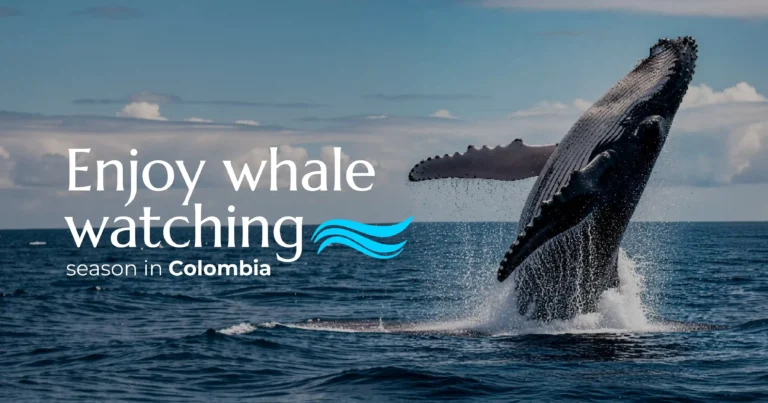
Every year, between 6,000 and 8,000 humpback whales swim more than 8,000 kilometres from the cold waters of Antarctica and southern Chile to the warm shores of the Colombian Pacific. They come here to mate, to give birth, and to teach their calves their first breaches. It’s one of the most extraordinary migrations on the planet, and it unfolds within reach of anyone willing to witness it.
In this guide, we’ll walk you through when whale watching season happens in Colombia, the best destinations to see them, what you can expect to observe, and how to experience it all with respect for the animals and for the communities that welcome them.
When Is Whale Watching Season in Colombia?
The official whale watching season in Colombia runs from 1 July to 31 October 2026. Across those four months, humpback whales (also known as “yubartas”, Megaptera novaeangliae) reach the Colombian Pacific after one of the longest migrations in the animal kingdom, seeking warm, shallow waters where they can breed safely.
Some destinations extend the window into early November, but the peak of the spectacle happens right in the middle of the season.
When to See Whales in Colombia: Month by Month
- July: the first groups begin to arrive. It’s a quieter month and a great option if you want to avoid crowds.
- August: one of the best months. There’s already a steady presence of whales, including courting males whose underwater songs can sometimes be heard from the boats.
- September: the month most recommended by naturalists. This is when mothers appear with their newborn calves, teaching them their first jumps.
- October: sightings are still active, with fewer tourists and slightly lower prices. Ideal if you prefer a calmer trip.
The Best Destinations for Whale Watching
The Colombian Pacific offers several destinations, each with its own character. These are the five most recommended:
1. Bahía Málaga (Uramba, Buenaventura)
Located in the Valle del Cauca department, Uramba Bahía Málaga National Natural Park is the destination with the longest whale-watching tradition. Its sheltered bays make it a true sanctuary for mothers with calves. You reach it from Cali, and local boat trips depart from Ladrilleros and Juanchaco.
2. Nuquí (Chocó)
One of the most remote and magical corners of the Pacific. It combines whale watching with tropical rainforest, natural hot springs, surf breaks and a cuisine built around fresh seafood. Direct flights from Medellín take you there, and the best bases are Guachalito, Termales or Coquí.
3. Bahía Solano (Chocó)
North of the Tribugá Gulf, Bahía Solano is the favourite among travellers who want to combine whale watching with beach time and jungle walks. Playa Almejal and El Valle are the most comfortable areas to stay.
4. Utría National Natural Park
Between Nuquí and Bahía Solano, Utría Cove is a natural refuge where humpback mothers often spend weeks caring for their calves in calm waters. Because it’s a protected area, visits require permits and follow strict rules.
5. Gorgona Island
A former prison island turned National Park, and a UNESCO World Heritage site. It offers one of the most spectacular whale-watching experiences in the country, framed by rainforest and coral reefs. Access is by boat from Guapi.
What Can You See During a Sighting?
Watching a humpback whale surface just metres from your boat is an experience you won’t forget. During a typical outing, you’re likely to witness:
- Breaching: when a 40-tonne whale launches itself out of the water and crashes back with a boom that echoes across the bay.
- Tail and fin slaps: rhythmic slaps against the surface that serve as a form of communication between individuals.
- Underwater songs: males sing songs that can last up to 20 minutes. On boats equipped with hydrophones, you can listen to them live.
- Mothers with calves: the most moving image of all, especially in August and September.
Responsible Whale Watching: How to Do It Right
The growth of tourism has raised legitimate concerns about practices that can disrupt the whales’ natural behaviour. That’s why clear protocols exist, protocols every operator must follow and every traveller can rightfully expect:
- A minimum distance of 200 metres from the animals.
- No chasing or surrounding the whales.
- Slowing down the boat when cetaceans are detected.
- Limiting observation time and avoiding clusters of boats around a single group.
- Keeping silence or speaking softly during sightings.
As Miguel Ángel Martínez, a member of Pacífico Biocultural, puts it: “a good sighting doesn’t mean being closer to the whales, but observing them without altering their natural behaviour”.
Practical Tips for Your Trip
- Book well in advance. Flights to Nuquí and Bahía Solano are limited and fill up fast. Aim to book between March and May.
- Plan at least 4 or 5 days. The Pacific weather and sea are unpredictable. More time means more chances of a great sighting.
- Pack light but waterproof. This is a humid region with frequent rain. A windbreaker, quick-dry clothing and a dry bag are essential.
- Bring reef-safe sunscreen. The sun here is intense, and the coral reefs are fragile.
- Choose certified local operators. They know the currents, ensure the rules are respected, and keep the economic benefits within the Pacific communities.
Experience Whale Watching Season with Colombia Memories
Seeing whales in Colombia is an experience that blends nature, culture and the coastal communities of the Pacific. It’s also a logistically complex trip, with limited flights, a short season, and a strong ethical dimension. That’s why doing it with the right team beside you makes all the difference.
At Colombia Memories, we design tailor-made trips to the Colombian Pacific in partnership with certified local operators and the Afro-Colombian communities who have looked after these coasts for generations. As a Travelife Partner Certified company, we make sure every sighting respects the whales, contributes to the local economy and delivers an unforgettable experience. We accompany you in your own language before, during and after your trip.
Want to experience the 2026 whale watching season with the best possible guidance? Tell us what you dream of and we’ll design your trip to the Colombian Pacific together.
Frequently Asked Questions (FAQ)
When is whale watching season in Colombia?
From 1 July to 31 October. August and September are the most recommended months.
Where can you see whales in Colombia?
Along the Colombian Pacific coast: Bahía Málaga (Buenaventura), Nuquí, Bahía Solano, Utría National Park, Gorgona Island, Tumaco and Guapi.
What kind of whales arrive?
Humpback whales, also called yubartas (Megaptera novaeangliae), which travel more than 8,000 km from Antarctica and southern Chile.
How long does a whale watching outing last?
On average, between one and three hours, depending on the destination and operator.
Is whale watching safe for the whales?
Yes, when done with certified operators who keep the 200-metre distance, avoid chasing the animals and limit observation time.
EXCELLENT Based on 254 reviews
 Posted on Google
 Aldo Alberto Dell'AglioAgenzia super seria con Camillo e il suo team! Esperienza indimenticabile!Posted on Google
 Raffaella LandiniGrande professionalità, sempre vicini alle esigenze di noi viaggiatori. Ottime scelte sui luoghi proposti.Posted on Google
 Anne MarchalSuperbe voyage en Colombie paysage , ville et villages riches en couleurs. SUPER ACCUEIL et ORGANISATION très bien ficelée ( jusqu’au proposition de plusieurs restaurants dans chaque ville ! ) L’équipe sur place en Colombie était très professionnelle et réactive ( pour nos éventuels changements de programme ) . Tout s’est passé sans problème ou inquiétude ! Très bonne agence Merci pour nous avoir accompagnés.. Grâce à vous nous avons passé de très très belles vacances . MerciPosted on Google
 Baptiste FaraudSéjour pour voir le Cerros de Mavecure réservé très facilement par cette agence (et Camillo Di Vaio !). Programme réalisé selon nos envies et qui s’est passé sans encombres ! Merci beaucoup encore !Posted on Google
 Chiara Atzeni Di MontaCamillo e tutto il team di Colombia Memories hanno organizzato il nostro viaggio in Colombia con grande cura, attenzione, gentilezza e professionalità. Hanno saputo gestire con prontezza anche alcune modifiche dell’ultimo minuto dovute al terremoto di agosto 🥲, assistendoci in ogni momento e non facendoci mai sentire soli. Un supporto davvero prezioso, che ci ha permesso di vivere il viaggio con serenità e senza stress. Consiglio vivamente Colombia Memories a chiunque voglia scoprire questo meraviglioso Paese!Posted on Google
 BARBARA GRIMOLDII ragazzi di Colombia memories sono stati molto in gamba nell’organizzare il mio viaggio in Colombia ad agosto e sono riusciti a fare andare tutto per il meglio, nonostante una variazione di itinerario pochi giorni prima della partenza, a causa del terremoto. Tutto organizzato nei minimi dettagli. Servizi, come hotel e trasferimenti, ottimi, e guide sempre disponibili, gentili e professionali. I ragazzi dell’agenzia sono sempre a disposizione per qualsiasi informazione o esigenza prima della partenza e durante il viaggio, tramite whatsapp. Molto consigliato per chi vuole organizzare un viaggio personalizzato in Colombia! Un viaggio ricco di esperienze indimenticabili 😊Posted on Google
 Alessio LunghiL’agenzia è sempre stata presente e disponibile per supportarci durante il viaggio. Organizzazione impeccabile!Posted on Google
 Valentina MartinengoAbbiamo apprezzato molto il supporto del corrispondente locale durante tutto il viaggio. È stato sempre presente, scrivendoci quotidianamente per assicurarsi che tutto procedesse bene e fornendoci assistenza quando necessario. Molto buona la puntualità e l’organizzazione dei trasporti, così come la scelta degli hotel, generalmente soddisfacenti per rapporto qualità-prezzo, ad eccezione di una struttura. Un particolare ringraziamento va al team per la disponibilità dimostrata anche in occasione del terremoto, trovandoci in alcune delle zone coinvolte: ci hanno prontamente ricontattati, supportati e, dove necessario, aiutati a riorganizzare i trasferimenti e la sistemazione. Nel complesso un servizio attento e affidabile, che ci ha fatto sentire seguiti durante tutto il viaggioPosted on Google
 abramo lorenzo albrigiAbbiamo organizzato il viaggio tramite l’agenzia e ci siamo trovati molto bene. Ottima organizzazione e assistenza immediata in caso di pecca o problema, anche non dipendente da loro. ConsigliatoPosted on Google
 patricia sotoUna atencionn inmejorable. Personas encantadoras tanto los guias como los choferes que nos atendieron en todo en viaje. Siempre estaban atentos y cualquier dificulta y la resolvían con rapidez y eficacia. Muchas gracias equipo por hacer de este viaje una experiencia maravillosa.